Business Finance / 4 MIN READ
How to Write Budget vs. Actual Variance Commentary (With Examples)
Turn budget variances into clear explanations. Learn a practical commentary structure with revenue, expense, timing, and forecast examples.
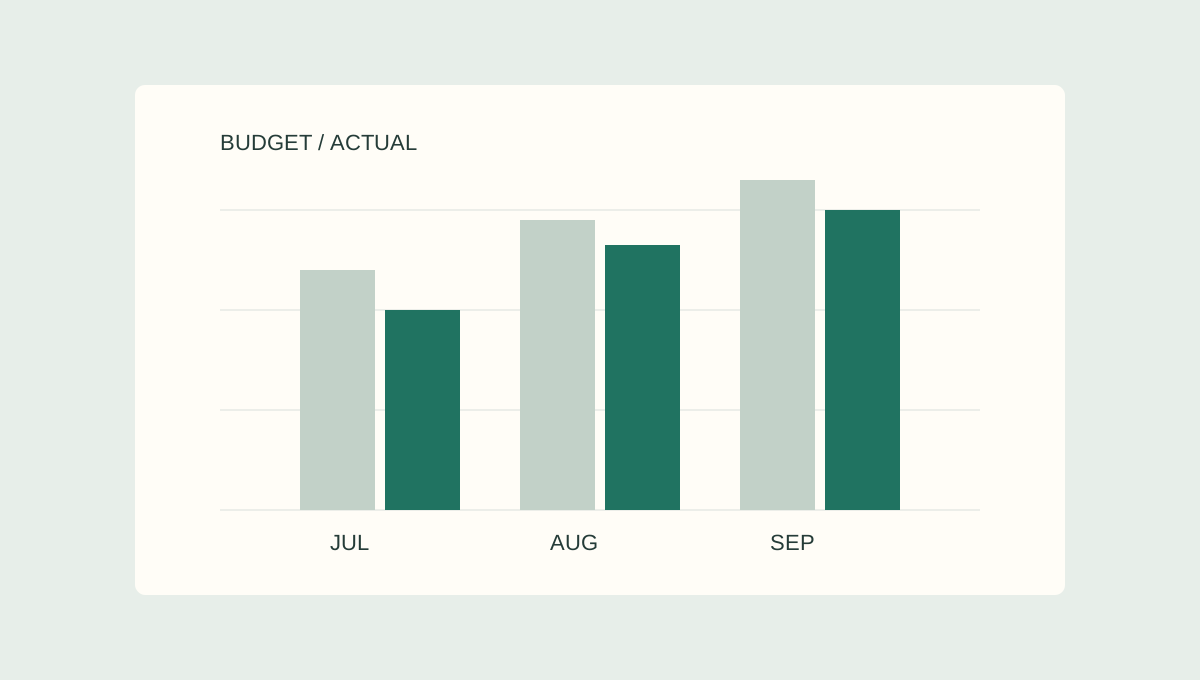
A variance tells you what changed. Good commentary explains why it changed, whether it will continue, and what happens next. The goal is to help a reader make a decision without having to reconstruct the spreadsheet.
The examples below are fictional training examples, not results from The Finance Desk or its customers.
Start with a consistent calculation
Use variance = actual − budget. For a budget of $100,000 and actual revenue of $92,000, the variance is −$8,000, or −8%. Calculate the percentage as (actual − budget) ÷ budget × 100. When budget is zero, show “not meaningful” and explain the dollar movement instead of dividing by zero.
A positive number is not always favorable. Revenue above budget is usually favorable; expenses above budget are usually unfavorable. Label the business impact explicitly and keep your sign convention consistent.
Use a four-part commentary structure
- Result: State the dollar and percentage variance, period, and scope.
- Driver: Explain the cause using evidence, not a restatement of the number.
- Outlook: Say whether the movement is timing-related or likely to persist.
- Action: Identify the next step, accountable role, and review date.
Use this reusable prompt: “[Line item] was [amount] ([percent]) [above/below] budget, driven by [verified cause]. [Timing or recurring impact]. [Owner] will [action] by [date].”
Example 1: Revenue below budget
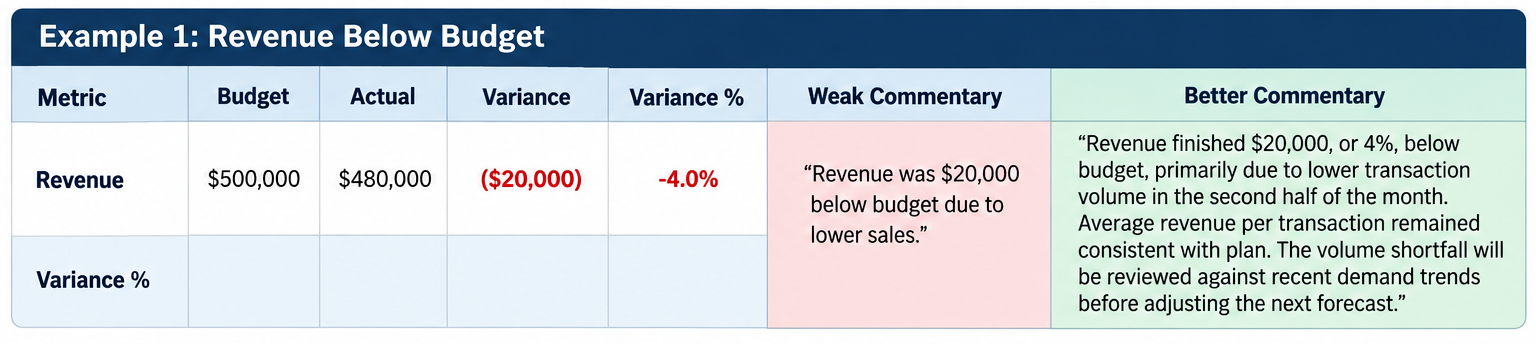
Revenue of $480,000 against a $500,000 budget is a $20,000 (4%) unfavorable variance. In this illustrative scenario, transaction volume declined while average revenue per transaction held steady. The useful next step is to review whether lower volume is temporary before revising the forecast.
Example 2: Payroll above budget
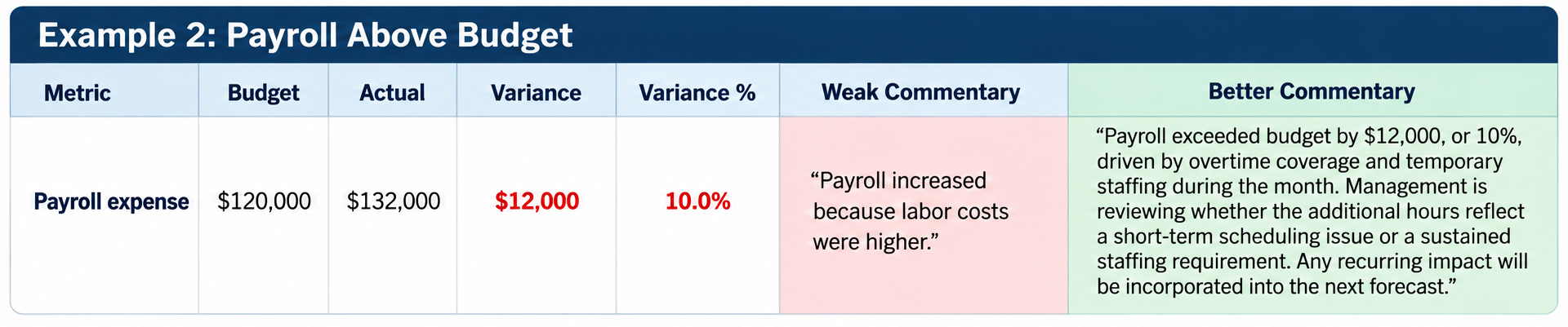
Payroll of $132,000 against a $120,000 budget is a $12,000 (10%) unfavorable variance. In this illustrative scenario, overtime and temporary staffing drove the increase. Confirm whether those hours are temporary or represent an ongoing staffing need before updating the forecast.
Example 3: Gross margin below expectations
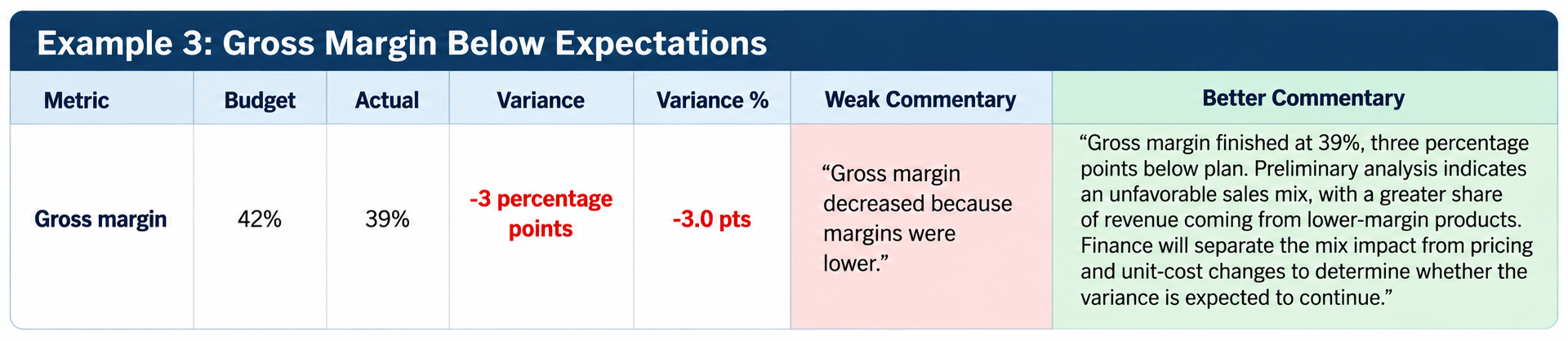
Gross margin of 39% versus a 42% plan is three percentage points unfavorable. In this illustrative scenario, a shift toward lower-margin products is the preliminary explanation. Validate the mix effect separately from pricing and unit-cost changes before treating it as confirmed.
Separate the causes before you write
Look for price or rate changes, volume differences, changes in mix, timing, and one-off items. Use invoices, transaction detail, or operational records to support the explanation. Avoid counting the same driver twice. If the cause is still being investigated, say so and give a follow-up date.
Define materiality with your team. A percentage can look dramatic on a small balance, while a small percentage on a large line can matter. Review both dollars and percentages, and explain significant offsets when the net movement hides meaningful changes.
A quick review checklist
- Does the commentary identify the period and budget version?
- Do the causes reconcile to the dollar variance?
- Is favorable or unfavorable clearly labeled?
- Are timing differences separated from recurring changes?
- Is the action specific, with an owner and review date?
- Does the forecast reflect the evidence available today?
Put the explanation beside the numbers
Keep a commentary column alongside budget, actual, dollar variance, and percentage variance. Add owner and follow-up fields if the report supports a recurring review. This makes each explanation easier to update next month.
Explore the Business Finance hub for the reporting workflow, or browse The Finance Desk on Payhip to review the current template catalog and product details.
Frequently asked questions
How long should variance commentary be?
Usually a short paragraph is enough for one material movement. Add detail when multiple causes, uncertainty, or a decision needs explanation.
Should every variance have commentary?
Use an agreed materiality threshold and judgment. Focus on movements that affect decisions, commitments, or the forecast, while investigating unusual patterns even when they fall below a threshold.
Can I use the same explanation next month?
Reuse the structure, but recheck the facts. Confirm whether expected timing reversals happened, update the evidence, and close or revise the action.
PUT IT INTO PRACTICE
Variance Brief
Compare actuals with budget and forecast, investigate material variances, and draft commentary from your inputs.
View Variance Brief on PayhipCheck Payhip for current pricing and compatibility.
Educational content. Examples are fictional and should be adapted and checked against your own reporting policies.
More from Business Finance →