Stock & Options Tracking / 4 MIN READ
What Happens When an Options Spread Expires? Assignment, Exercise and Settlement
Understand expiration outcomes for vertical option spreads, including short-leg assignment, pin risk, cash settlement, and why defined-risk payoffs need careful management.
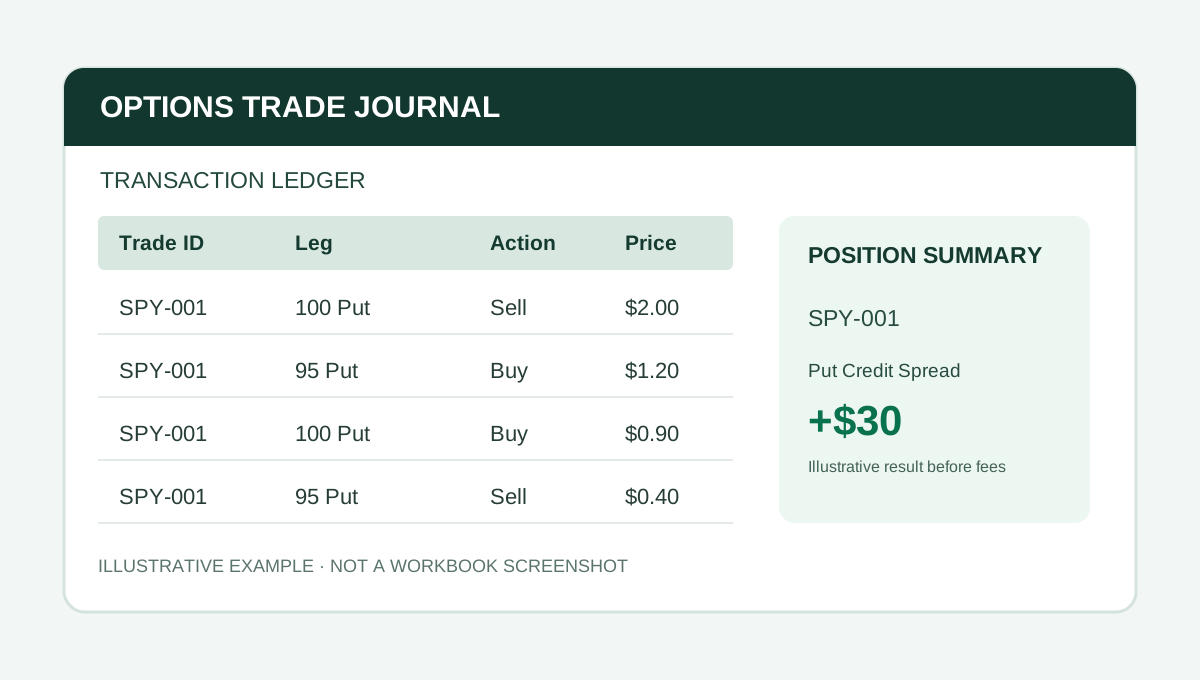
An options spread has a theoretical payoff at expiration, but the actual account outcome can depend on exercise, assignment, settlement type, and broker procedures. A spread that looks defined-risk on a payoff chart can still leave a trader with an unexpected stock position when only one leg is exercised or assigned.
This guide explains the mechanics using fictional examples. It is educational, not a recommendation to hold a spread through expiration.
First, identify what you own
A vertical spread combines a long and a short option of the same type and expiration at different strikes. A credit spread collects a net premium at entry; a debit spread pays a net premium. Theoretical maximum profit and loss are based on a complete spread and its specified expiration payoff.
The details below focus on standard US equity options that are physically settled. Index options may be cash settled, have European-style exercise, or use different expiration and settlement conventions. Always check the actual contract specification.
What happens to an in-the-money option?
A long equity option that finishes in the money is generally subject to the Options Clearing Corporation's exercise-by-exception process, subject to applicable thresholds and contrary instructions. This does not mean every contract is automatically exercised in every situation. Broker cutoffs can occur before the clearinghouse deadline.
A short option can be assigned when its holder exercises. You cannot rely on the holder's decision matching your expectation, and assignment notices may arrive after trading ends.
An out-of-the-money option typically expires without exercise, but holders may submit contrary instructions. Prices can also change after the regular session closes.
Example: a put credit spread near the short strike
Suppose a trader sells a 100 put and buys a 95 put, receiving a hypothetical $0.80 credit. The spread is $5 wide. For one standard 100-share contract pair, its textbook expiration payoff has a maximum gross profit of $80 and maximum gross loss of $420, before fees and operational complications.
If the stock closes at $102 and both puts expire unexercised, the trader ordinarily retains the credit.
If it closes at $97, the short 100 put is in the money while the long 95 put is out of the money. Assignment of the short put can require buying 100 shares at $100, while the long put may expire. The resulting stock position can move after expiration. This is one reason a vertical's expiration diagram is not a complete operational-risk model.
If the stock closes below $95 and both legs are exercised or assigned as expected, their opposing stock deliveries generally offset, producing the theoretical width-based payoff. Timing, broker actions, contrary exercise instructions, and account constraints can still affect the actual outcome.
What is pin risk?
Pin risk describes uncertainty when the underlying price is near a strike at expiration. A small move, especially around the close, can determine whether a leg is exercised or assigned. The trader may not know the final stock exposure until later.
For a spread with one strike in the money and the other out of the money, the account can end up with stock exposure even though the trader originally entered a spread.
Cash-settled index options are different
Certain index options settle in cash rather than shares, and some use a special opening settlement value rather than the last quoted index price. A trader should verify whether the contract is AM- or PM-settled and whether it is European- or American-style. Do not assume SPY, QQQ, XSP, and SPX have identical exercise and settlement mechanics.
A practical expiration checklist
- Identify the exact underlying, option style, settlement method, and last trading time.
- Confirm both strikes, expiration date, quantities, and any partial fills.
- Check your broker's exercise and liquidation policies and deadlines.
- Understand what stock position could result if only the short leg is assigned.
- Account for after-hours movement and potential margin requirements.
- Do not interpret a theoretical maximum loss as a guarantee against operational exposure.
Should a trader close before expiration?
Closing a spread before expiration can eliminate some exercise and assignment uncertainty if all legs are actually filled and the position is fully closed. It can cost a debit or sacrifice remaining premium, and orders are not guaranteed to fill. The right choice depends on the contract and account; this article does not prescribe a trading action.
For payoff arithmetic, see how to calculate credit spread profit and loss in Excel or use our free vertical spread calculator. The calculator illustrates theoretical outcomes, not broker-specific expiration processing.
Further reading
The Options Industry Council provides educational material on exercise and assignment. Read the OCC Characteristics and Risks of Standardized Options before trading options. Confirm the terms of the specific contract and your broker's instructions.
Bottom line: A spread's theoretical risk limit and its expiration processing are related, but they are not the same thing. Know what each leg can become before expiration arrives.
PUT IT INTO PRACTICE
Options Command Center
Connect fills, legs, rolls, and adjustments by Trade ID, with position summaries and strategy reporting.
View Options Command Center on PayhipCheck Payhip for current pricing and compatibility.
Educational content. Examples are fictional and should be adapted and checked against your own reporting policies.
More from Stock & Options Tracking →